Understanding Childhood Behaviors and Their Impact on Adult Relationships

Children’s behavior often draws quick judgments from adults: “Don’t embarrass me,” or “That child is so unruly.” These comments focus on the surface actions without asking what the child is really trying to manage. What happened here? What feelings or needs lie beneath the behavior?
This pattern of misunderstanding can follow us into adulthood, especially in romantic relationships. One partner may act reactive, withdrawn, controlling, or clingy, while the other responds with blame or coldness. Judging behavior alone rarely softens these patterns. Instead, it often makes them worse.
Understanding the roots of these behaviors can open the door to healing and stronger connections.
How Childhood Shapes Behavior
Children adapt to the emotional environment around them. They may become quiet and pleasing, funny and distracting, defiant and challenging, overly mature, or hard to reach. These behaviors are often survival strategies, not fixed character traits.
For example, a child in a chaotic home might learn to be overly responsible to keep peace, while another might act out to gain attention or withdraw to protect themselves from pain. These responses help the child manage difficult feelings and situations.
Recognizing these behaviors as adaptations rather than flaws helps us approach them with compassion.
The Role of Family Dynamics
In family systems, children often take on roles to maintain connection or reduce conflict. These roles include:
The Hero: The responsible, high-achieving child who tries to bring pride and stability.
The Scapegoat: The child who acts out, carries blame, or becomes the identified problem, often drawing attention away from or amplifying the family’s unspoken pain.
The Lost Child: The quiet, withdrawn child who avoids conflict by staying unnoticed.
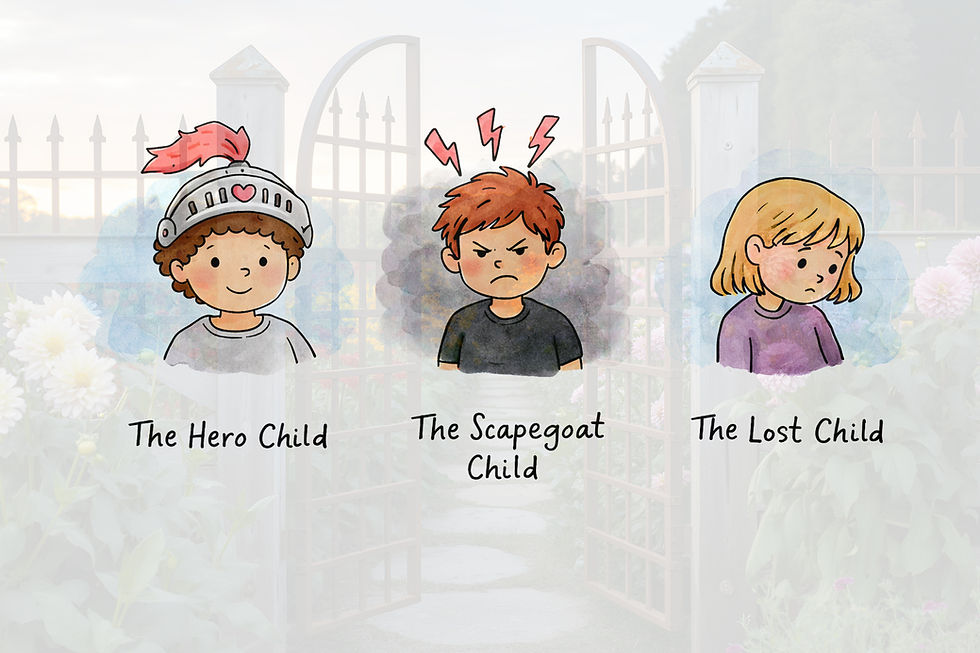
These roles are not signs of failure or bad character. They are survival positions shaped by the cost of connection in that family. What once helped preserve family bonds may later create challenges in adult relationships.
How Childhood Behaviors Affect Adult Relationships
The survival strategies learned in childhood often continue into adult romantic relationships. For example:
A partner who learned to withdraw to avoid conflict may find it hard to express needs clearly and lovingly, then grow frustrated when those needs remain unmet. What once felt protective in childhood can later create distance and loneliness in adult love.
Someone who acted out as a child may become reactive or defensive when vulnerability, shame, or fear is stirred. Beneath the intensity, there is often a younger part bracing for blame, rejection, or not being understood.
A person who took on the Hero role may feel responsible for keeping everything together, and struggle when life or love feels messy, uncertain, or out of control. They may look strong on the outside while feeling privately burdened, exhausted, or afraid to let others down.
These patterns can create cycles of blame, coldness, or disapproval between partners. Instead of softening wounds, judgment often deepens them.
Seeing Behavior as Armor
From a Relational Life Therapy (RLT) perspective, many adult behaviors are Adaptive Child strategies—automatic protections built around a more vulnerable core. The behavior is the armor; the innocence lies underneath.
For example, a partner who seems controlling may actually be trying to protect themselves from feeling powerless. Another who withdraws might be guarding against emotional pain.
Recognizing the armor helps partners move beyond blame and toward understanding.
Healing Through Insight and Responsibility
Adulthood offers something childhood could not: insight, responsibility, and the ability to change. Healing begins when we ask:
What is underneath this behavior?
What was learned from childhood experiences?
What is needed now to feel safe and connected?
This shift in perspective allows partners to see each other’s pain and needs, rather than just their behaviors. It opens the way for empathy and new ways of relating.
Practical Steps to Support Change
Here are some ways to begin healing childhood patterns in adult relationships:
Pause before reacting: Notice when old patterns arise and ask what feelings or needs are behind them.
Communicate openly: Share your experiences and listen without judgment.
Seek understanding: Explore family roles and childhood experiences together.
Build safety: Create an environment where vulnerability is met with support, not blame.
Consider therapy: A therapist trained in relational approaches can guide this process.
Moving Forward with Compassion
What once made sense as a survival strategy may no longer be loving or helpful. Recognizing this is the first step toward change.
By looking beneath behaviors to the needs and fears underneath, we can break cycles that harm intimacy. This understanding helps build relationships based on connection, respect, and healing.
The journey is not easy, but it is possible. With insight and care, childhood wounds can transform into sources of strength and deeper love.
Reach Out to Begin
If these patterns feel familiar in your relationship, you do not have to untangle them alone. I offer RLT-informed couples counselling and individual relational work to help you understand the deeper roots of conflict and begin creating more honest, connected ways of relating.


Comments